Victoria Falls safari
The Smoke that thunders
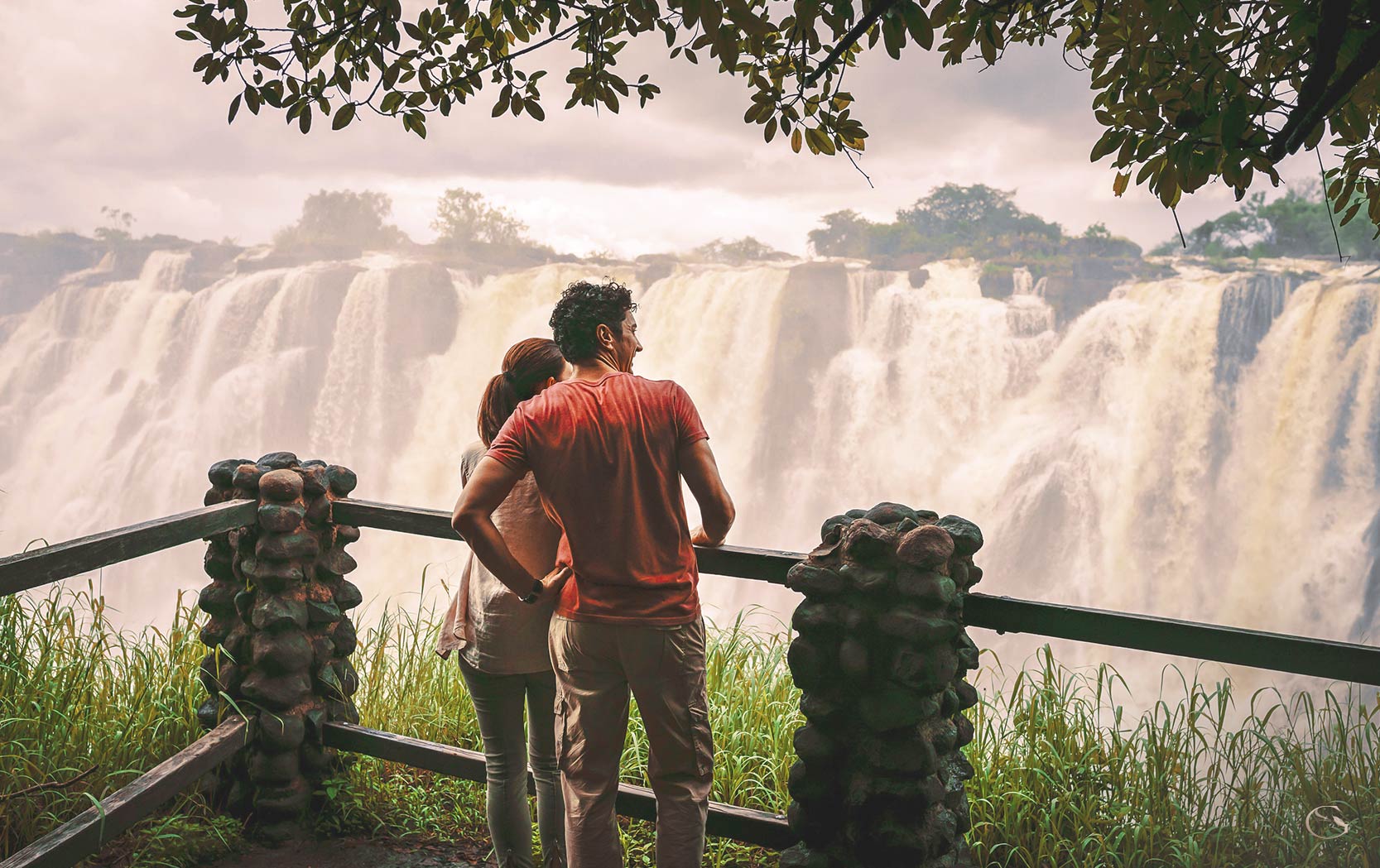
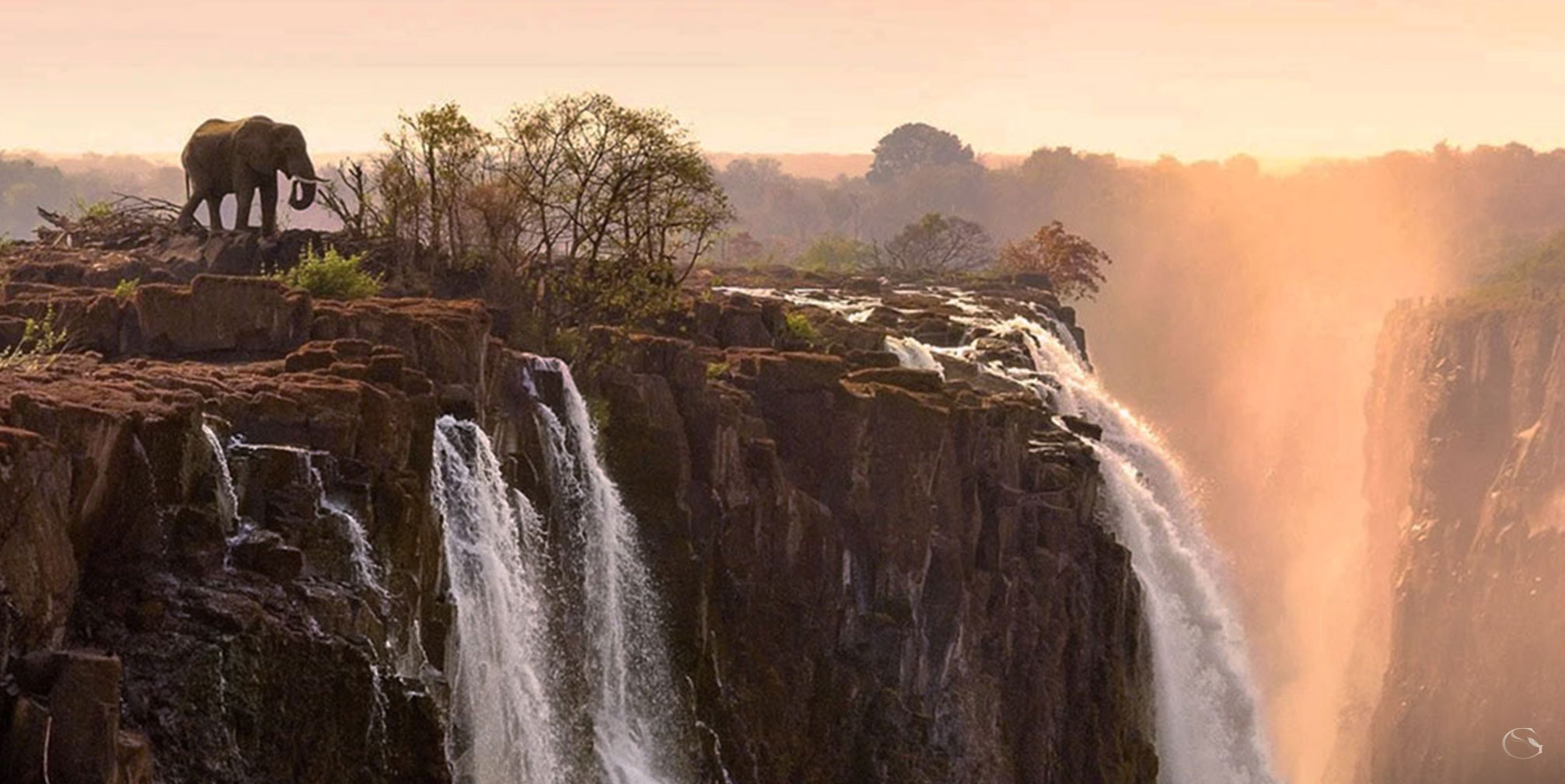
At the border of two countries. Covering a width of 5406 ft, the Victoria Falls is sited between Zambia and Zimbabwe.
Mosi-oa-Tunya · The Smoke That Thunders
Where the Zambezi Lets Go
A mile of river steps off the edge of Africa — the spray climbs so high the forest on the rim stays green all year.
Classified as the largest falling sheet of water on Earth Victoria Falls is nearly double the height of Niagara falls and twice-over the width of Horeshoe falls. It is one of the most popularly visited areas in the southern half of Africa. The two islands on the crest of the falls are: Cataract Island, near the western bank and Livingstone Island near its middle, where the 1800s explorers first viewed the Falls. At full moon, a “moon bow” appears over the Victoria Falls. The site of the Falls has offered discovery of many archaeological artifacts, some dating 3 million years. These stone age tools are presented in the museum at Victoria Falls.
Safari experience
When the summer rains descend between December and March, the rivers swell, and the mighty Falls grow ever more spectacular. By April, May, and June, when the waters surge to their breathtaking 1700-meter-wide zenith, a walk across the bridge or along the winding trails guarantees you’ll be drenched by the misty embrace of the Falls. Though the skies may be a brilliant blue, the sheer power of the spray often veils the view, making a helicopter ride the best way to fully grasp and feel the wonder of this natural masterpiece at its most majestic. The Falls in Figures: 355ft height at center, a flow of 38,430 cu ft per second.
Safari Films
The smoke that
thunders.

Victoria Falls
The edge of Africa
The edge of Africa
THE SMOKE THAT THUNDERS During the Jurassic age, some 150 to 200 million years ago, fiery volcanic forces painted Southern Africa’s landscape in thick layers of basalt. As the molten earth cooled and hardened, the crust fractured, and in these deep cracks, clay and lime took root. Over eons, erosion and the powerful course of the Zambezi River carved through the softer veins, giving birth to the first in a cascade of waterfalls. Mosi-oa-Tunya, “the smoke that thunders,” roared long before the Western world knew its name. It was not until 1855, when Dr. David Livingstone gazed upon this awe-inspiring marvel, that it was christened Victoria Falls, named in honor of his British queen—a mere blink in the span of geological time.
Victoria Falls
The island on the brink
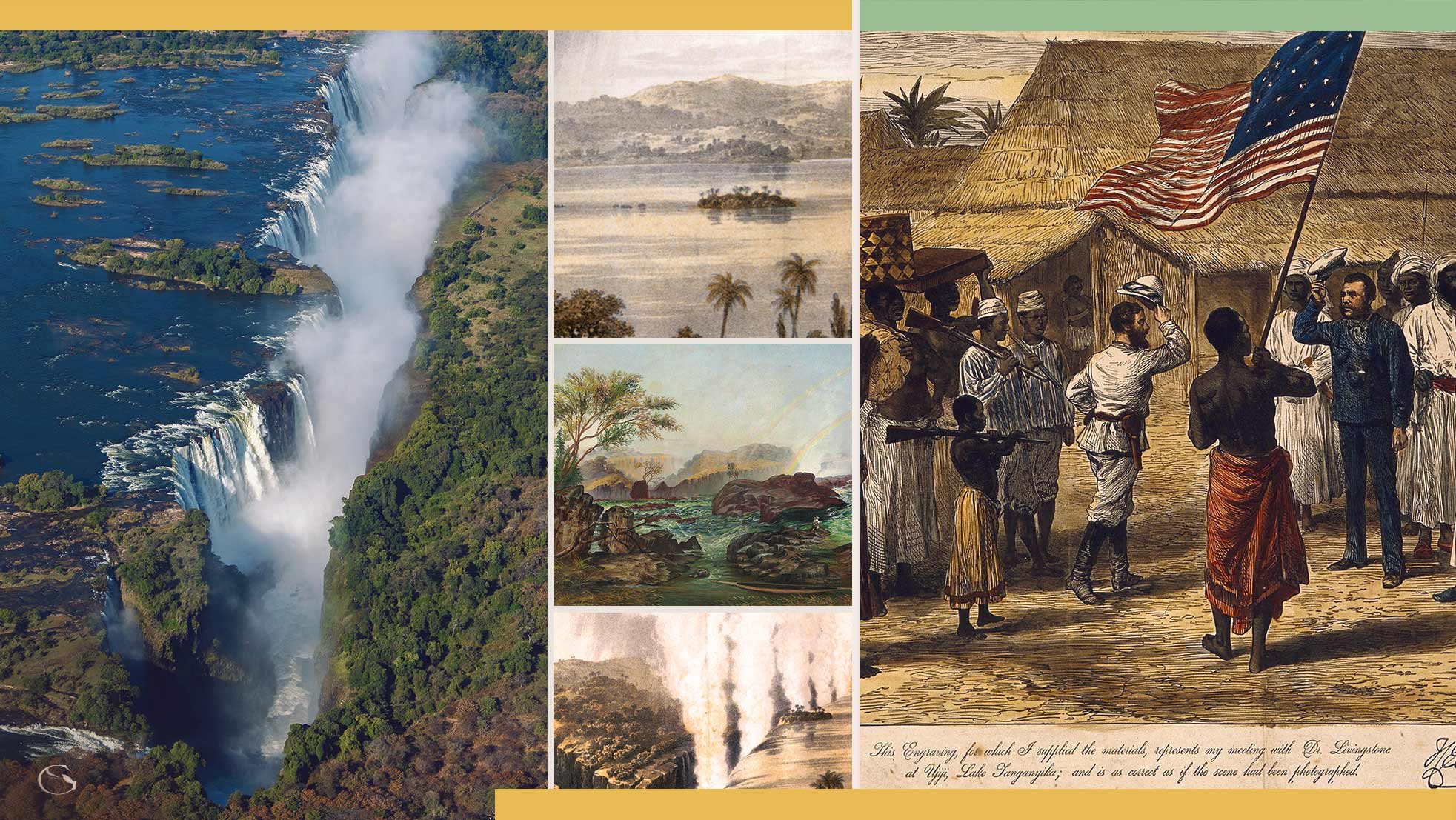
On 17 November 1855, Chief Sekeletu of the Makololo tribe guided Dr. Livingstone by canoe to a small island in the Zambezi, then known as Goat Island. Though the river’s waters were low that day, a "tremor of fear" stirred within Livingstone as he drew near the towering wall of mist and spray, sensing the immense power of the falls even from afar. Peering down into the swirling abyss below must have been a breath-stealing moment, one that surely quickened the heart. Today, you too can stand where Livingstone once stood, on what is now called Livingstone Island, reachable from the Zambian side during the dry season. For the daring, a dip in Devil’s Pool awaits—right at the brink of the precipice, where the waters whisper of wonder and dread at the immensity of the scene.
Victoria Falls
The famous meeting
In 1866 David Livingstone, a medical missionary and Victorian-era explorer, embarked a transcontinental expedition across Africa in search of the source of the Nile River. With almost half a decade past in the dark continent without word from his end, The New York Herald charged Henry Stanley with the task of searching out Livingstone. On November 10, 1871 Stanley found Livingstone in an African village with the immortal introduction: "Dr. Livingstone, I presume?"
This is where our story of the Victoria Falls begins. When Livingstone arrived at the Falls, called Mosi-oa-Tunya by the people; The Smoke That Thunders, he christened it with its current western name, in honor of Queen Victoria (1837–1901).
There are over 300 cultural heritage sites in the town of Livingstone, Zambia. This includes archaeological sites, historical buildings, engineering structures, traditional sites and national monuments. The Victoria Falls Field Museum was built around an actual excavation of the Zambezi River. This museum includes exhibits that display the various forms of life around the Victoria Falls from more than 50,000 years ago to the present.
Victoria Falls
The river's seasons
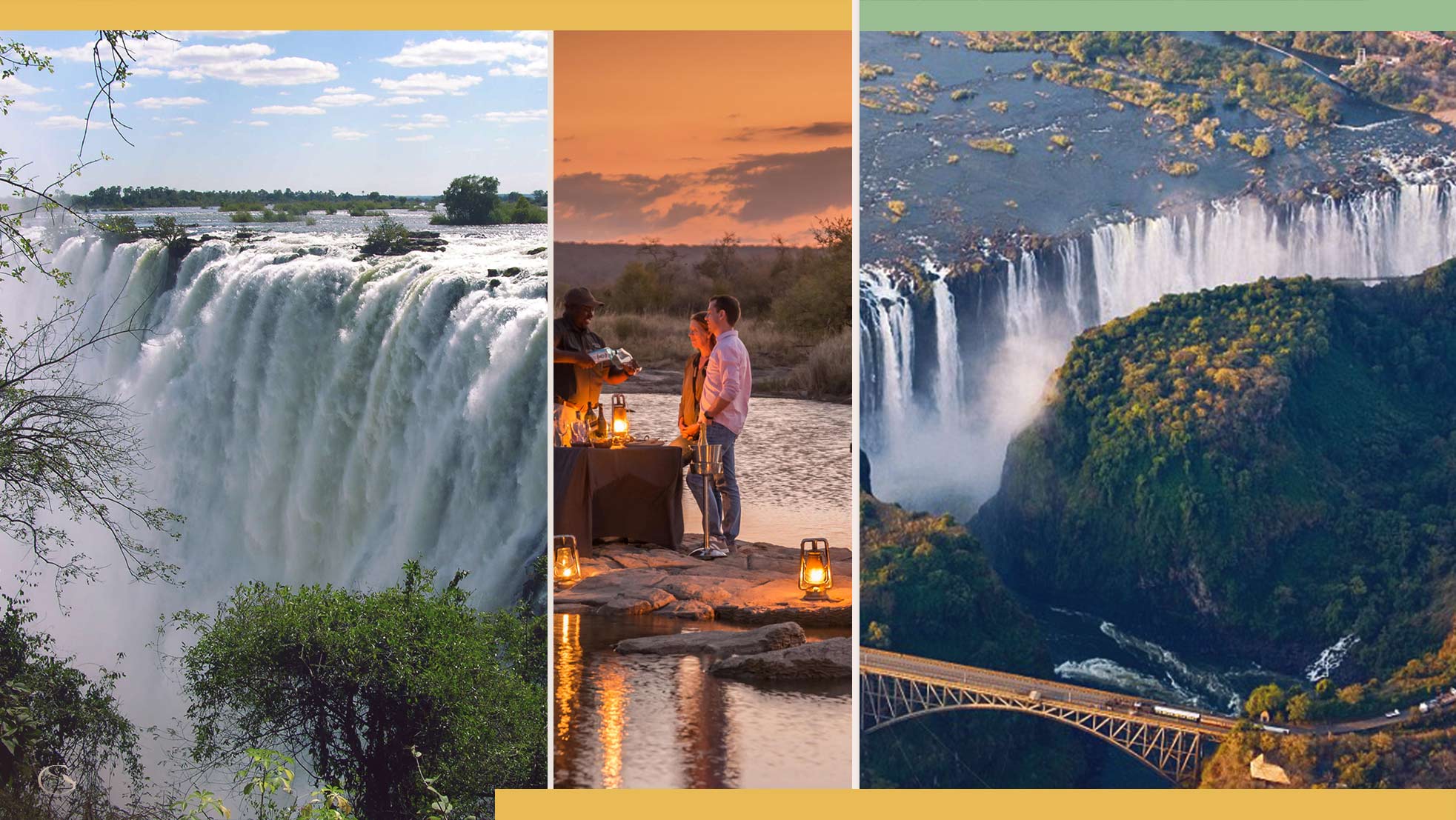
The Zambezi River flowing upstream of the Victoria Falls experiences a summer rainy season from late November to April (when the weather is hottest and the Falls at their fullest by February). During this time the spray rises to almost 1300ft, visible from 30 miles away. It is impossible to see the foot of the falls and most of its visage, with walkways shrouded in constant shower, shooting upward like inverted rain closer to the edge of the cliff, resulting in heavy mist.
Victoria Falls are typically at their highest flow in the early dry, winter months from May through June. At this time the falls may generally span the entire width of 1.7km of the Zambezi crest; regrettably however, at this time the spray is far too great to be up close! In the hot, rainy, summer months typical to the region, from October through December the falls divide into strands of subgroups instead of the postcard illusion of “fullness” from a single sheet, leaving much of the bedrock wall exposed. At this time, water activities are possible at the Victoria Falls. Those unaccustomed to high humidity however, will not find this a preferable time to travel to the Victoria Falls. From January onward, especially the area becomes more prone to thunderstorms and humidity is exceptionally high. However, at this time the Falls are at their fullest, perhaps, depending upon the flow of the Zambezi River on that given year.
July through September, in the full swing of the dry winter season (and its global relation to summer holidays) is generally the busiest time for the Victoria Falls, given a more pleasant climate and fewer problems with mist with a relatively acceptable volume of spray. The best time for visiting the Victoria Falls can be determined for our guests, according to their safari itinerary by the safari designers at Guided Safaris®
Guided Safaris®
A Day on Safari
Luxury Safari Camps


BROWSE THE EXPERIENCES HANDBOOK
Always Tailormade
Every detail defines an experience in your private safari.
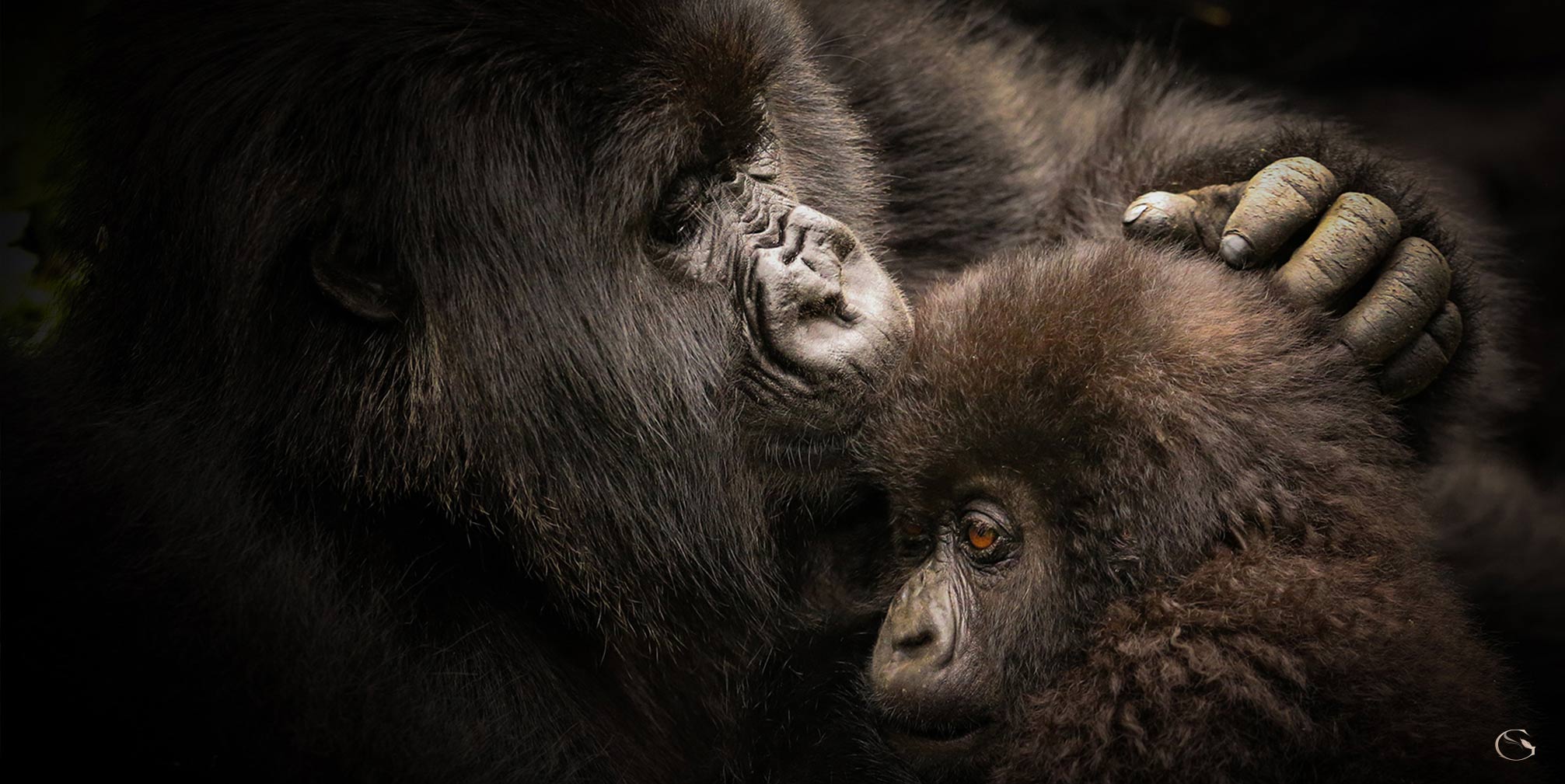
Our custom safaris are meticulously planned journeys where nothing is left to chance, so you can enjoy unique moments with your loved ones in total luxury and privacy. Having the ultimate say in your preferences from start to finish allows you to explore our exclusive destinations in absolute freedom, whenever you want. No set dates; no groups, ever.